
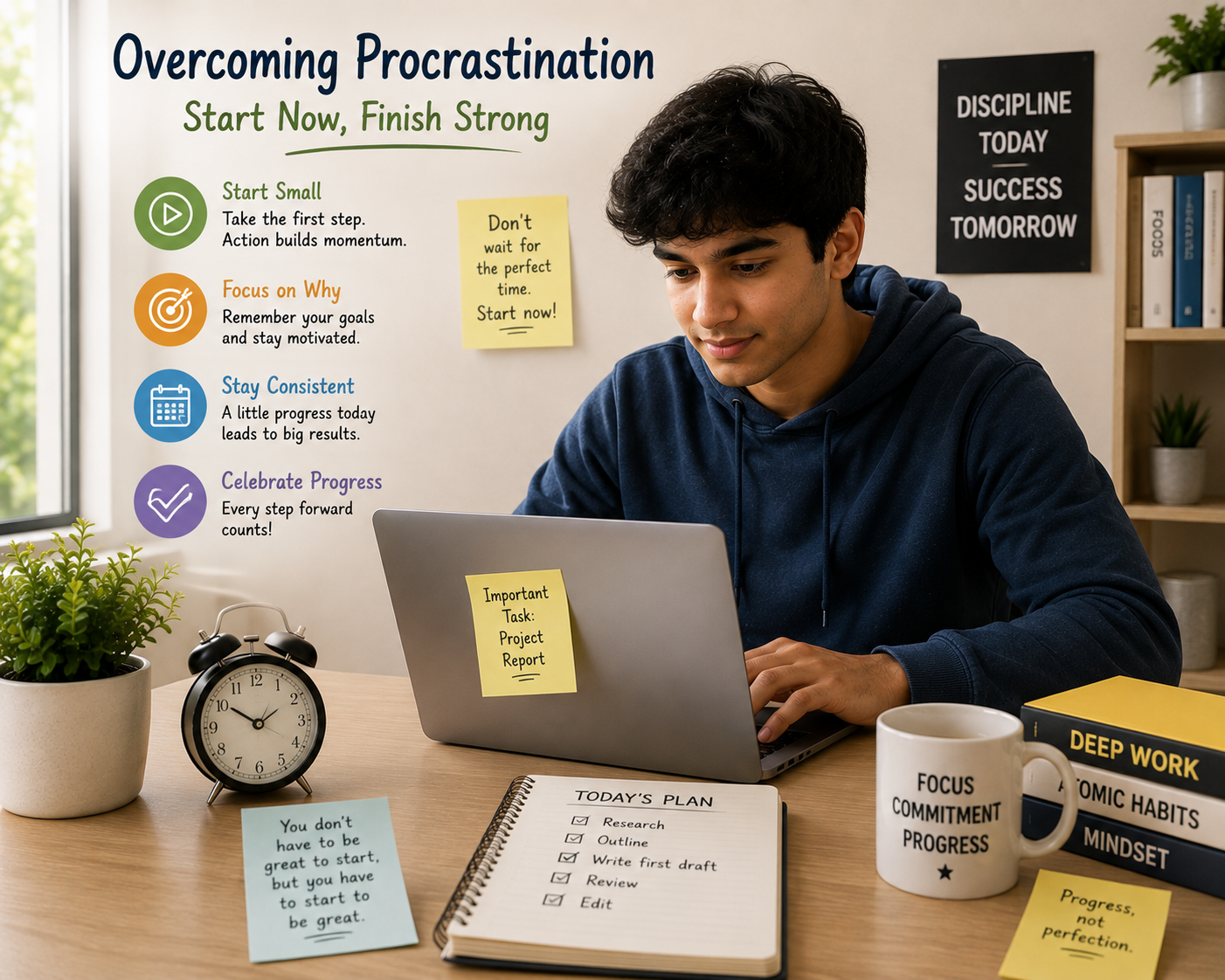
Learning how to reduce procrastination is therefore less about forcing yourself to work constantly and more about understanding why you’re delaying something.
Most people postpone tasks occasionally. An assignment may remain unfinished, an important email may be delayed, or a personal goal may keep getting pushed to another day.
Procrastination isn’t always caused by laziness. A task may feel boring, difficult, confusing, stressful, or uncomfortable. Sometimes, avoiding it provides temporary relief, but the unfinished responsibility often creates more pressure later.
Once you make the first step easier, taking action can become much more manageable.
Why Do People Procrastinate?
Procrastination often begins when the emotional cost of starting feels greater than the immediate reward of avoiding the task.
A large project may seem overwhelming. A difficult subject may create uncertainty. Even a simple responsibility can feel unpleasant when you’re tired or distracted.
The mind may then choose an easier activity, such as checking social media or watching videos.
Unfortunately, temporary relief doesn’t remove the responsibility. The task remains, while the available time becomes smaller.
Recognizing this pattern is an important starting point.
8 Ways to Reduce Procrastination
1. Make the First Step Extremely Small
Large tasks can create unnecessary mental resistance.
Instead of telling yourself to “finish the entire project,” identify the smallest useful action.
Open the document. Write the heading. Read the instructions. Collect one source. Solve the first question.
The objective isn’t to finish everything immediately.
You simply want to make starting easier.
Once you’ve begun, continuing often feels less difficult than it did when the task was only an idea in your head.
2. Remove the Pressure to Finish Perfectly
Perfectionism can quietly encourage procrastination.
You may delay starting because you believe the first attempt needs to be excellent. As a result, the task remains untouched while you wait for the right mood, idea, or amount of confidence.
Give yourself permission to create a rough first version.
A first draft can be improved. An imperfect answer can be corrected. A basic plan can be expanded later.
Progress gives you something to improve, while waiting for perfection gives you nothing to work with.
3. Set a Short Starting Period
Telling yourself that you need to work for several hours can make a task seem exhausting before you’ve even begun.
Instead, choose a short period for your initial effort.
You might decide to study for fifteen minutes, write for ten minutes, or organize your notes for a short session.
During that period, focus only on the selected task.
When the time ends, you can decide whether to continue or take a break.
Often, getting started removes much of the resistance.
4. Identify What Is Making You Delay
Not every instance of procrastination has the same cause.
Perhaps the task is confusing. Maybe you’re worried about making mistakes. The responsibility could also be repetitive or simply uninteresting.
Ask yourself:
“What exactly am I avoiding?”
If the task is confusing, find instructions or ask someone for clarification.
When the problem is boredom, consider breaking the activity into shorter sessions.
If you’re worried about failure, focus on completing a basic first attempt.
Understanding the reason behind the delay makes it easier to choose a useful response.
5. Put Distractions Out of Reach
A difficult task becomes even harder when attractive distractions are immediately available.
Your phone, social media, entertainment, and unnecessary notifications can provide instant alternatives to work.
Before beginning, reduce those interruptions.
Silence nonessential notifications, close unrelated browser tabs, and place your phone somewhere that doesn’t demand your attention.
You don’t need extraordinary willpower when your environment supports the behavior you want.
6. Connect Tasks With a Specific Time
A task is easier to postpone when it exists only as a vague intention.
Compare these two statements:
“I’ll study later.”
“I’ll review Chapter 3 at 7:00 PM.”
The second statement creates a clearer commitment.
Choose a realistic time and prepare what you need beforehand.
When the scheduled time arrives, begin without spending too much time debating whether you feel motivated.
A consistent starting routine can gradually make action more automatic.
7. Reward Progress, Not Just Completion
Waiting until an entire project is finished before acknowledging your effort can make long tasks feel endless.
Instead, notice progress along the way.
After completing a meaningful section, take a short break, have a drink, stretch, or do something enjoyable.
The reward doesn’t need to be large.
The purpose is to create a healthier connection between effort and positive feedback.
Over time, completing small milestones can feel more satisfying than repeatedly avoiding the task.
8. Forgive Yourself and Restart Quickly
Sometimes procrastination happens despite your best intentions.
You may lose an evening to distractions and then feel disappointed in yourself.
Spending the next day criticizing yourself doesn’t complete the task.
A better response is to acknowledge what happened and restart.
Ask what caused the delay and decide what you can change next time.
One unproductive period doesn’t need to become an unproductive week.
Starting again quickly can prevent a small setback from becoming a larger pattern.
Procrastination and Student Life
Students often face multiple deadlines at once, making procrastination particularly tempting.
An assignment may seem far away, so studying gets postponed. Eventually, several responsibilities become urgent at the same time.
A better approach is to divide academic work into smaller milestones.
For a large assignment, you could separate research, outlining, writing, editing, and final review.
Each stage becomes a manageable responsibility rather than one enormous task.
Similarly, studying a subject over several shorter sessions can feel more manageable than attempting to learn everything the night before an examination.
What to Do When You Don’t Feel Motivated
Waiting for motivation can keep you stuck.
Motivation often appears after you begin rather than before.
You might not feel interested in studying at 6 PM, but completing the first few questions can create momentum.
Instead of asking, “Do I feel motivated?”, try asking, “What is the smallest useful action I can take?”
That question changes the focus from emotion to action.
You don’t need to feel enthusiastic about every responsibility. Sometimes, simply beginning is enough.
Avoid Turning Productivity Into Pressure
Reducing procrastination doesn’t mean filling every moment with work.
Rest, hobbies, social connections, and personal time are also important.
If your schedule becomes unrealistic, you may eventually become exhausted and return to avoidance.
Create goals that challenge you without making success impossible.
A sustainable routine gives you room for both responsibility and recovery.
Final Thoughts On Reduce Procrastination
Learning how to reduce procrastination begins with making action easier.
Break large tasks into smaller steps, remove unnecessary distractions, lower the pressure to be perfect, and give yourself a specific starting time. When you fall behind, avoid spending too much energy blaming yourself. Instead, understand what happened and begin again.
You don’t need to complete everything today.
You only need to identify the next useful action and take it.
That first step may seem small, but repeated small actions can gradually create a more consistent approach to work, study, and personal goals.
For another practical guide, explore Student Productivity: 8 Daily Habits for Academic Success.
For additional information about stress, motivation, and healthy behavior patterns, explore resources from the American Psychological Association.
Frequently Asked Questions On Reduce Procrastination
1. Why do people procrastinate?
People may postpone tasks because they feel difficult, boring, stressful, confusing, or uncomfortable. Understanding the specific reason can help identify a better solution.
2. How can I reduce procrastination quickly?
Choose one very small action and begin immediately. Opening the document, reading the instructions, or completing the first question can break the barrier to starting.
3. Does procrastination mean I’m lazy?
No. Procrastination can have many causes, including stress, perfectionism, uncertainty, distractions, and difficulty managing large tasks.
4. How can students avoid last-minute studying?
Breaking subjects and assignments into smaller sessions throughout the week can prevent several responsibilities from becoming urgent at the same time.
5. What should I do after procrastinating?
Avoid spending too much time blaming yourself. Identify what caused the delay, make one adjustment, and restart with a manageable action.