
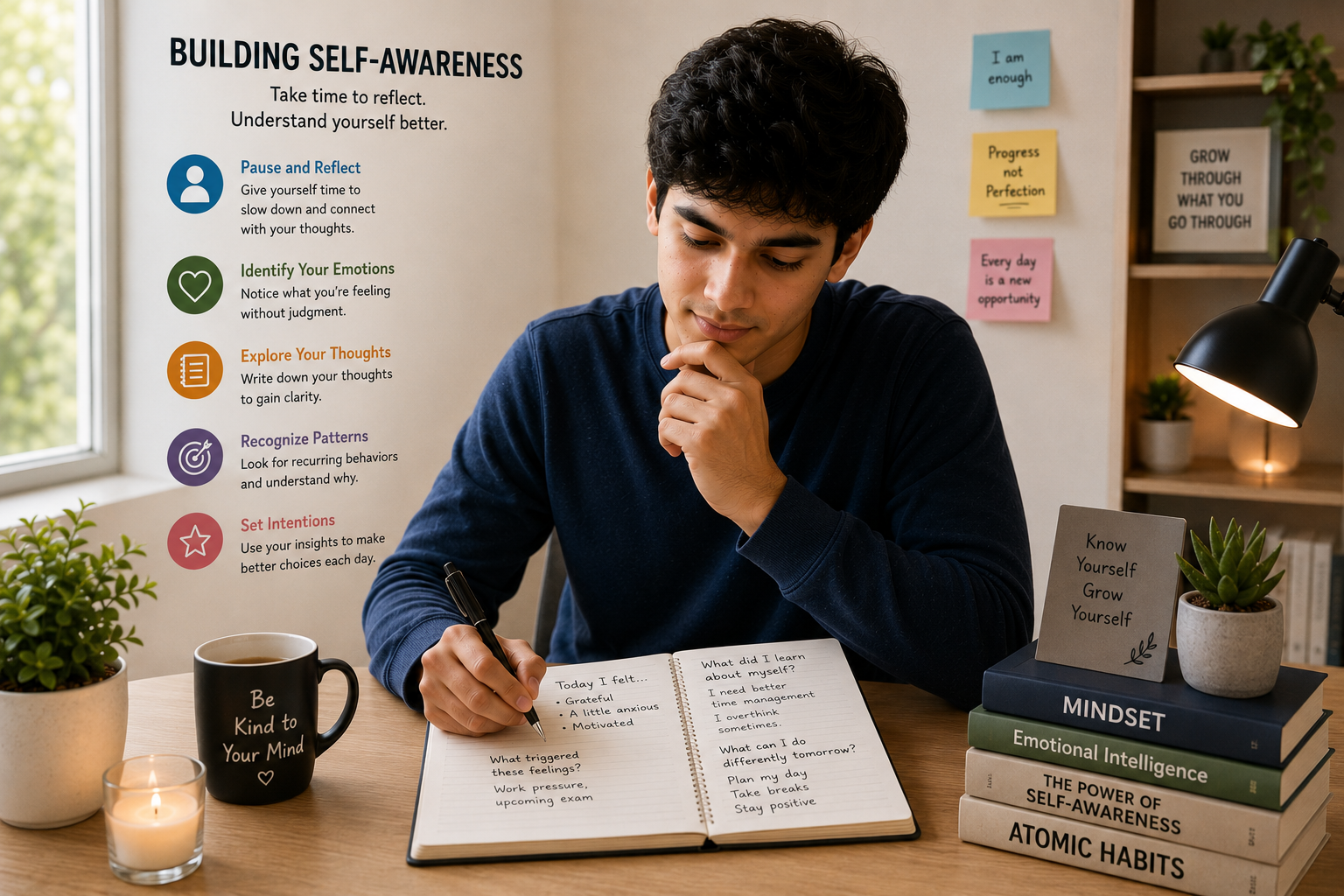
Build Self-awareness involves paying closer attention to your thoughts, emotions, behaviors, values, and reactions. It isn’t about analyzing yourself constantly or finding something wrong with your personality.
Instead, it gives you an opportunity to understand yourself more honestly.
When you recognize your patterns, you can make more deliberate choices instead of automatically reacting to every situation.
Why Build Self-Awareness Matters
Your thoughts and emotions influence many everyday decisions.
A stressful situation may make you react quickly. A fear of failure might cause you to avoid an opportunity. A strong personal value may influence which decisions feel right to you.
Without noticing these influences, you may sometimes react without understanding the reason behind your behavior.
Greater awareness creates a pause between what happens and how you respond.
That pause can help you consider whether your reaction matches what you actually want.
8 Ways to Build Self-Awareness
1. Pay Attention to Your Emotional Reactions
Emotions can provide useful information about your experiences.
When you suddenly feel irritated, nervous, excited, disappointed, or uncomfortable, don’t immediately dismiss the feeling.
Instead, ask yourself what happened just before it appeared.
Perhaps a particular comment made you feel criticized. Maybe an unexpected change created uncertainty. Another possibility is that you were already tired or stressed.
The goal isn’t to judge the emotion.
Simply noticing it can help you understand what situations affect you and why.
2. Notice Your Repeating Patterns
Some behaviors appear repeatedly without receiving much attention.
You might postpone certain responsibilities whenever they feel difficult. Perhaps you become quiet during disagreements or frequently seek reassurance before making decisions.
Look for patterns rather than focusing on one isolated incident.
Ask yourself:
“When does this usually happen?”
Identifying repeated situations can reveal habits that you may not have consciously recognized before.
Once a pattern becomes visible, you have a better opportunity to decide whether you want to change it.
3. Identify What Triggers You
Certain situations can produce stronger reactions than expected.
A particular type of criticism, uncertainty, disagreement, or pressure may affect you more than similar situations.
When this happens, take a moment to examine the situation.
Ask what specifically caused your reaction.
The purpose isn’t to blame yourself or another person. Understanding your triggers simply gives you more information about how you respond under pressure.
That knowledge can help you prepare for similar situations in the future.
4. Understand Your Strengths
Self-awareness isn’t only about identifying weaknesses.
Recognizing what you do well is equally important.
Think about situations where you perform effectively.
Perhaps you communicate clearly, remain patient during difficult tasks, learn new concepts quickly, organize information well, or support people around you.
Ask yourself which abilities consistently help you.
Understanding your strengths can help you choose responsibilities and opportunities where those qualities are useful.
It can also provide a more balanced view of yourself.
5. Accept Your Weaknesses Without Defining Yourself by Them
Everyone has areas that need improvement.
Maybe you struggle with organization, become impatient under pressure, avoid difficult conversations, or have trouble asking for help.
Acknowledging these limitations doesn’t mean labeling yourself as incapable.
Instead, treat them as areas for development.
For example, saying “I need to improve my organization” is more useful than deciding “I’m a disorganized person and can’t change.”
The first statement identifies a skill that can be developed.
6. Examine Your Values
Your values influence many of the choices you make.
Think about what matters most to you.
It might be honesty, independence, learning, family, creativity, reliability, achievement, kindness, or personal freedom.
Now consider whether your everyday decisions reflect those priorities.
Sometimes people feel dissatisfied because their daily behavior doesn’t match what they say is important to them.
Understanding your values can provide a clearer foundation for making choices that feel meaningful.
7. Listen to Constructive Feedback
Other people sometimes notice patterns that you don’t see yourself.
A trusted friend, teacher, colleague, or mentor may point out a behavior that you’ve never considered.
Feedback doesn’t mean you must accept every opinion about yourself.
Listen carefully and consider whether the observation matches situations you’ve experienced.
If several trustworthy people mention a similar pattern, it may be worth examining more closely.
Useful feedback can become an additional source of information about your behavior.
8. Reflect Before Reacting
Self-awareness becomes especially valuable when emotions are strong.
Instead of immediately responding to an upsetting message or difficult situation, create a small pause.
Ask yourself:
“What am I feeling?”
“Why am I reacting this way?”
“What response would actually help?”
A few seconds of reflection won’t solve every difficult situation, but it can prevent an automatic reaction from becoming a larger problem.
The more often you practise this pause, the more natural it can become.
Self-Awareness for Students
Students make decisions about subjects, friendships, careers, study routines, and future goals.
Understanding yourself can make some of these choices easier.
For example, you may discover that you learn better through practical examples rather than simply reading. You might realize that certain environments make it easier to participate in discussions, while others make you uncomfortable.
This information can help you make adjustments instead of assuming that one approach works for everyone.
Self-awareness can also help students recognize when academic pressure is affecting their behavior.
If you notice that stress repeatedly causes you to avoid assignments, for instance, you can focus on addressing that pattern rather than simply criticizing yourself for procrastinating.
Self-Awareness Is Not Overthinking
There is an important difference between reflection and endless analysis.
Reflection asks useful questions and looks for understanding.
Overthinking repeatedly revisits the same situation without producing a helpful conclusion.
If you spend hours analyzing every conversation or decision, the process may no longer be helping.
Give yourself a clear purpose when reflecting.
Ask what you can learn from the experience and whether there is anything useful you can do differently next time.
Once you’ve gained the information you need, allow yourself to move forward.
How to Build Self-Awareness Every Day
You don’t need to spend an hour analyzing yourself every evening.
A few minutes can be enough.
At the end of the day, think about one situation that affected you.
Consider what happened, how you responded, what you were feeling, and whether you would respond differently next time.
Writing these thoughts in a journal can help you notice patterns over several weeks.
The purpose isn’t to create a record of every emotion.
You’re simply collecting useful information about yourself.
Final Thoughts
Building self-awareness is a gradual process.
Pay attention to your emotional reactions, notice repeating patterns, identify your triggers, and recognize your strengths. At the same time, acknowledge areas where you can improve and consider whether your actions reflect your personal values.
Feedback from trusted people can provide another perspective, while pausing before reacting gives you an opportunity to make more deliberate choices.
You won’t understand every part of yourself immediately.
People change as they gain new experiences, face different challenges, and enter different stages of life.
What matters is remaining curious about your own behavior instead of judging yourself too quickly.
The next time you experience a strong reaction, pause for a moment and ask yourself why.
That simple question can be the beginning of a deeper understanding of yourself.
For another Rational Works article, explore How to Handle Criticism Without Losing Confidence.
For additional information about personality, emotions, and personal development, explore resources from the American Psychological Association.
Frequently Asked Questions
1. What is Build self-awareness?
Self-awareness is the ability to recognize and understand your thoughts, emotions, behaviors, values, strengths, and areas for improvement.
2. Why is self-awareness important?
It can help you understand your reactions, recognize behavioral patterns, make more thoughtful decisions, and identify areas where you want to grow.
3. How can students develop self-awareness?
Students can reflect on their reactions, recognize learning preferences, identify strengths and weaknesses, consider personal values, and seek constructive feedback.
4. Is self-awareness the same as overthinking?
No. Self-awareness involves useful reflection that leads to understanding. Overthinking often involves repeatedly analyzing situations without reaching a helpful conclusion.
5. Can self-awareness improve decision-making?
Understanding your emotions, values, preferences, and recurring patterns can give you more information when considering different choices.