
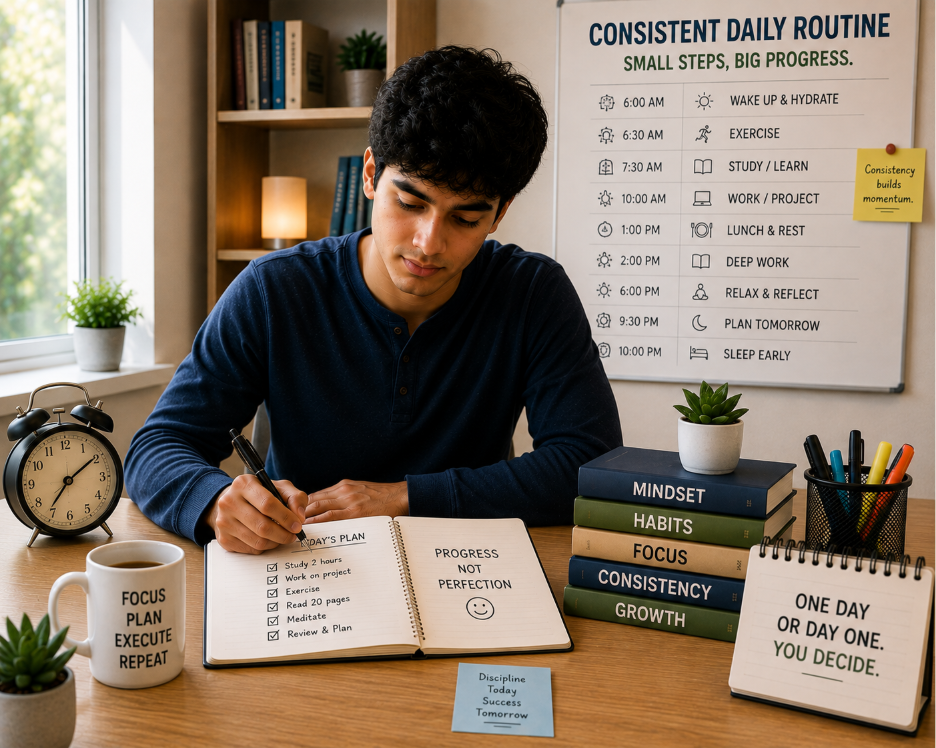
Building consistency means learning how to keep moving forward even when motivation changes. It doesn’t require doing everything perfectly or making dramatic improvements every day. The focus is on creating reliable actions that you can repeat over time.
Whether you’re working toward an academic goal, professional milestone, personal project, or healthier lifestyle, consistent effort can help turn intentions into meaningful progress.
Why Building Consistency Matters
Big results are rarely created by one extraordinary day.
A student improves through repeated study sessions. A professional develops expertise through continued practice. Someone learning a new skill becomes better by returning to it regularly.
Consistency creates repeated opportunities to improve.
It also makes progress easier to measure. Instead of wondering whether you’re getting better, you can look at what you’ve actually done over several weeks or months.
The objective isn’t perfection.
A sustainable routine that you can maintain is often more useful than an ambitious plan that disappears after a few days.
8 Ways to Build Consistency
1. Start With a Realistic Commitment
An ambitious routine can look impressive on paper but become difficult to maintain.
If you decide to exercise for two hours every day when you currently exercise very little, the plan may quickly become overwhelming.
Choose an amount that fits your current life.
You could begin with twenty minutes of exercise, fifteen minutes of reading, or one focused learning session.
A smaller commitment gives you a realistic starting point.
Once the routine becomes familiar, you can increase the challenge gradually.
2. Connect Actions to Existing Routines
New habits can be easier to remember when they are connected to something you already do.
For example, you might review your goals after breakfast or practise a new skill immediately after finishing work.
The existing activity becomes a reminder for the new one.
This reduces the need to decide when to begin each day.
Over time, the sequence can become more automatic.
3. Focus on the Process
Goals are useful because they provide direction, but constantly thinking about the final result can become discouraging.
A large goal may take months to achieve.
Instead, focus on the actions that move you toward it.
If your goal is to improve your writing, concentrate on writing regularly.
Someone preparing for an examination can focus on completing planned study sessions rather than worrying about the final score every day.
The process is where your daily choices have the greatest influence.
4. Make Progress Easy to See
Visible progress can provide useful feedback.
Keep a simple record of completed workouts, study sessions, practice hours, or other meaningful activities.
You don’t need complicated tracking software.
A calendar, notebook, or basic digital note can be enough.
Seeing several completed sessions together can remind you that your efforts are accumulating.
Tracking also helps identify patterns.
You may discover that certain days or situations consistently make your routine harder to maintain.
5. Prepare for Difficult Days
A routine shouldn’t depend on every day going perfectly.
Unexpected responsibilities, tiredness, travel, deadlines, or personal commitments can interfere with your plans.
Instead of assuming you’ll never miss a day, decide in advance what you’ll do when circumstances become difficult.
You might reduce the activity rather than abandoning it completely.
For example, if your normal workout is thirty minutes, a busy day might allow only ten.
Maintaining some connection with the routine can make returning easier.
6. Avoid the All-or-Nothing Mindset
Missing one day doesn’t erase your previous effort.
A common mistake is thinking that once a routine is interrupted, the entire plan has failed.
That mindset can turn one missed session into several weeks of inactivity.
Treat interruptions as temporary.
If you miss Monday, return on Tuesday.
If one study session goes badly, continue with the next one.
Consistency doesn’t mean never breaking the pattern.
It means repeatedly returning to it.
7. Reduce Unnecessary Decisions
Having to decide what to do every day can create friction.
Prepare your environment and schedule in advance where possible.
Keep your workout clothes ready. Prepare study materials before your session. Decide what topic you’ll practise before opening your notebook.
These small preparations reduce the number of decisions required at the moment of action.
A clear starting point can make it easier to follow through.
8. Review Your Routine Regularly
Consistency doesn’t mean refusing to change your approach.
Your circumstances can change.
A routine that worked during college may not fit your schedule after starting a job. A plan designed for a quiet month may need adjustment during a busy period.
Every few weeks, consider what’s working and what isn’t.
Ask yourself whether the routine is realistic, whether certain steps are unnecessary, and whether the activity still supports your current goal.
Making thoughtful adjustments can help keep the routine sustainable.
Consistency for Students
Students often have several competing priorities.
Classes, assignments, examinations, social activities, family responsibilities, and personal interests can make it difficult to maintain a fixed routine.
A flexible approach can help.
Instead of creating an unrealistic schedule that fills every hour, identify the activities that matter most.
A student might decide to review class material for a short period after returning home or dedicate specific days to particular subjects.
The exact schedule can vary.
What matters is creating a repeatable pattern that supports learning.
Consistency at Work
Professional development also depends on repeated effort.
Improving communication, learning new technology, developing leadership skills, or building industry knowledge rarely happens through one intense session.
Regular practice creates familiarity and experience.
For example, spending a small amount of time each week learning a professional skill may be easier to sustain than attempting to complete a large course during one weekend.
Long-term development often comes from continuing after the initial excitement disappears.
Motivation Isn’t Always Reliable
Motivation can be helpful when starting something new.
However, it naturally changes.
Some days you’ll feel enthusiastic. Other days you’ll feel tired or distracted.
If your routine only works when motivation is high, maintaining it can become difficult.
Consistency creates another source of momentum.
When an activity already has a place in your routine, you don’t need to make a major decision every time.
You simply follow the next step.
This doesn’t mean ignoring your energy or forcing yourself through exhaustion.
It means reducing your dependence on temporary enthusiasm.
What to Do After Breaking Your Routine
Everyone experiences interruptions.
The important question isn’t whether your routine was broken.
It’s how quickly and realistically you return.
Avoid spending too much time criticizing yourself.
Instead, identify what caused the interruption.
Was the goal unrealistic? Did your schedule change? Were there too many competing responsibilities?
Use the answer to make the next attempt more practical.
Returning without unnecessary guilt can prevent a temporary setback from becoming a permanent stop.
Consistency Doesn’t Mean Doing the Same Thing Forever
A consistent person isn’t someone who follows an identical routine regardless of circumstances.
Life changes.
Your priorities, responsibilities, interests, and available time can all shift.
A strong routine should be adaptable enough to survive those changes.
The underlying commitment can remain while the specific method changes.
You might study in the morning during one period of your life and in the evening during another.
The schedule changed, but the commitment to learning remained.
Final Thoughts On Building Consistency
Building consistency is about creating a pattern of action that you can realistically maintain.
Start with a manageable commitment and connect new activities to routines you already follow. Focus on the process, track visible progress, and prepare for days when your schedule doesn’t go according to plan.
Don’t let one missed day convince you that you’ve failed.
Return to the routine and continue.
As your circumstances change, review and adjust your approach rather than abandoning the goal completely.
Progress doesn’t need to be dramatic to be meaningful.
A small action repeated regularly can eventually become a significant part of your development.
The next time you set an important goal, don’t only ask yourself what you want to achieve.
Ask yourself what small action you can realistically repeat.
That question can turn a good intention into a lasting practice.
Frequently Asked Questions On Building Consistency
1. What does building consistency mean?
Building consistency means developing a reliable pattern of actions that supports a goal over time, even when motivation or circumstances change.
2. How can I become more consistent?
Start with realistic commitments, connect new actions to existing routines, reduce unnecessary decisions, track progress, and return quickly after interruptions.
3. Does consistency require doing something every day?
No. The appropriate frequency depends on the goal. What matters is following a sustainable pattern rather than forcing daily action when it isn’t necessary.
4. What should I do if I miss a day?
Treat it as an interruption rather than a failure. Identify what caused it and return to your routine as soon as reasonably possible.
5. Is consistency more important than motivation?
Motivation can help you begin, but a sustainable routine can help you continue when motivation naturally changes.