
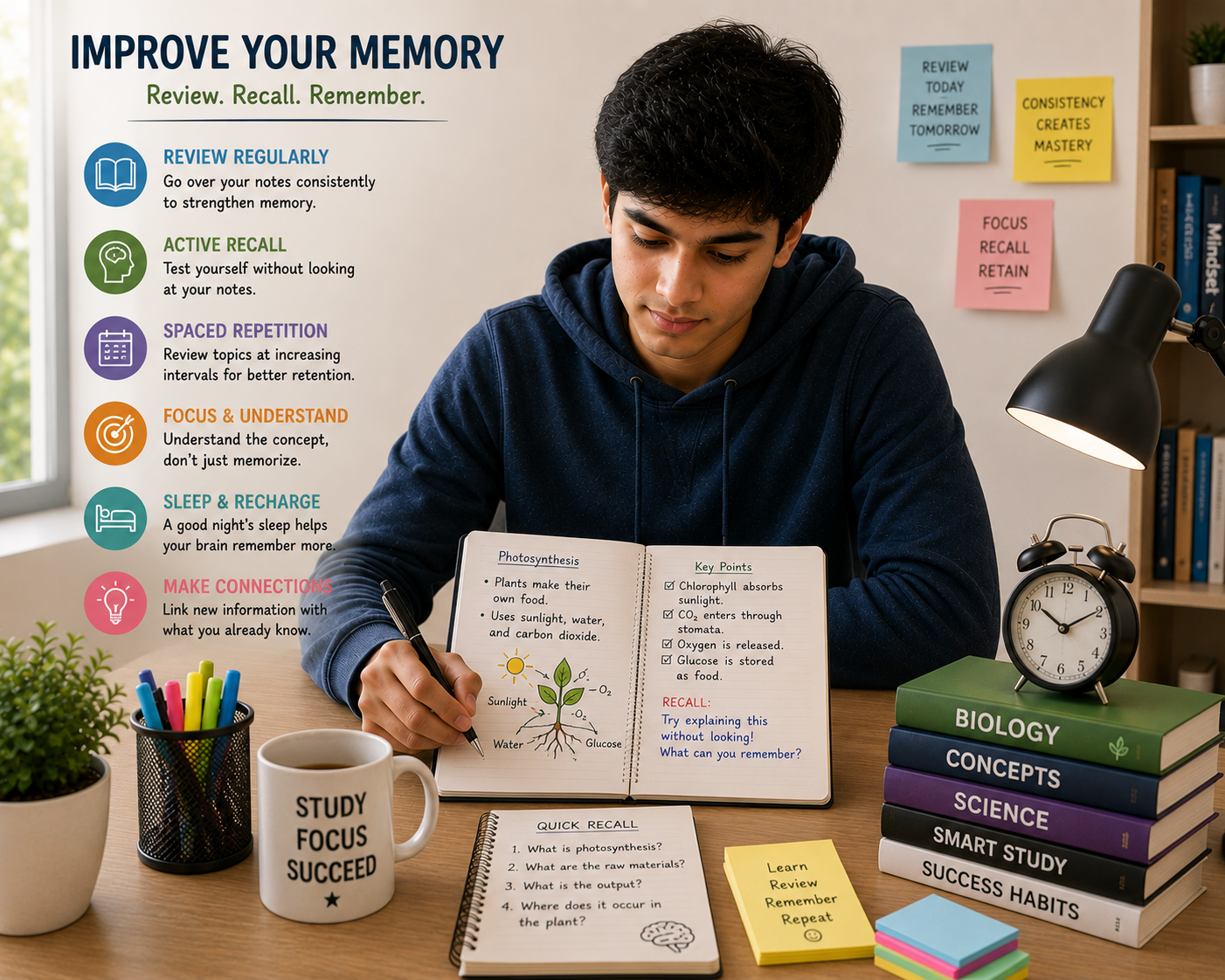
Learning how to improve memory involves using strategies that support understanding, recall, repetition, and healthy daily habits. These methods can be especially useful for students preparing for exams. They can also help anyone who wants to remember information more effectively.
Remembering information can sometimes feel difficult, especially when you are studying a large amount of material. You may read a chapter several times and still struggle to recall important details later.
The solution is not always spending more hours with your books. Instead, the way you approach learning can make a significant difference.
Finding methods that fit naturally into your routine can make learning easier and more manageable.
Why We Forget Information
Forgetting is a normal part of learning.
Information can become harder to recall when we do not use it, review it, or connect it to something meaningful. Simply reading material once does not guarantee that you will remember it later.
Distractions can make this harder because your attention may not become fully engaged with the information.
Therefore, effective learning involves more than exposure. You need opportunities to understand, recall, and revisit what you have learned.
8 Practical Ways to Improve Memory
1. Understand Before Memorizing
Memorizing information without understanding it can make learning feel difficult.
Before trying to remember a definition, formula, or concept, ask yourself what it actually means.
Connect new information to something you already know. For example, if you are learning a technical concept, think about where it is used and why it matters.
These connections can make the material easier to recall later. Understanding also gives information context instead of leaving it as an isolated fact.
2. Test Yourself Regularly
One simple way to check your learning is to stop looking at your notes and try to recall the information.
Close the textbook and explain the main points from memory. You can also create questions based on the material and answer them without checking the answers immediately.
This process shows you what you genuinely remember.
When you discover a gap, return to that section and review it before testing yourself again.
3. Review Information More Than Once
Learning everything during one session can be difficult.
Instead, revisit important material across multiple study sessions.
You might learn a topic today, review it later in the week, and return to it again before an examination.
These repeated encounters give you additional opportunities to retrieve the information.
Shorter reviews spread across time can also feel more manageable than one extremely long study session.
4. Explain Concepts in Your Own Words
Repeating textbook sentences does not always prove that you understand the material.
Try explaining the concept as though you are teaching it to another student.
Use simple language and describe the main idea without relying on the original wording.
If you struggle to explain something, identify the part you do not understand and review it again.
This method encourages you to process information rather than simply recognize familiar sentences.
5. Connect New Information to Examples
Abstract information can be easier to remember when you connect it to something concrete.
Look for an example from everyday life, create your own example, or think about where the concept might be used.
A student learning economics could connect a theory to something happening in a local market. Someone learning programming could relate a concept to a small application.
The example does not need to be complicated.
A useful connection can give your memory another way to access the information.
6. Write Short Notes
Writing everything from a textbook can consume a lot of time without necessarily improving understanding.
Instead, create concise notes containing the most important ideas.
Use headings, keywords, short explanations, and examples.
Your notes should help you remember the material rather than reproduce the entire chapter.
Later, you can use these notes for quick review and self-testing.
7. Protect Your Sleep
Learning does not happen only while you are sitting at your desk.
Sleep is an important part of maintaining a healthy routine, and consistently sacrificing sleep for additional study time can make learning more difficult.
Rather than regularly studying late into the night, try to create a schedule that gives you enough opportunity to rest.
A well-rested mind is generally better prepared for attention and learning than one that is constantly exhausted.
8. Reduce Distractions While Learning
Information is harder to retain when your attention keeps moving between different activities.
A phone notification, social media feed, conversation, or unrelated browser tab can interrupt your learning.
Before beginning an important study session, reduce unnecessary distractions.
Put your phone away if you do not need it, close unrelated applications, and prepare the materials required for the task.
Focused attention gives your brain a better opportunity to process the information you are trying to learn.
Memory Strategies to Improve Memory for Students
Students often need to remember definitions, concepts, dates, formulas, processes, and large amounts of reading material.
Rather than treating every subject in exactly the same way, match the strategy to the information.
For factual material, self-testing and repeated review can be useful.
complex concepts, explaining the idea in your own words and connecting it to examples may be more effective.
For subjects that require problem-solving, practising questions can be more useful than repeatedly reading solutions.
The goal is to move from simply seeing information to actively working with it.
Improve Memory When You Keep Forgetting
Repeatedly forgetting the same information can be frustrating.
Instead of reading it again and again, change your approach.
Ask yourself why you are struggling to remember it.
Maybe the concept is not fully understood. Perhaps you are confusing it with another idea. You might also need more opportunities to recall it without looking at your notes.
Try explaining it aloud, creating an example, writing a short summary, or turning it into a question.
Changing the way you interact with the information can reveal what was missing from your previous approach.
Avoid Relying Only on Last-Minute Study
Cramming can create a sense of urgency, but it also places a large amount of learning into a very short period.
A more sustainable approach is to begin earlier and revisit important material regularly.
You do not necessarily need several hours every day.
A short review session can help maintain familiarity with previously learned topics while allowing you to focus on new material as your course progresses.
Starting earlier also gives you time to identify difficult areas before the examination becomes urgent.
Improve Memory for Everyday Learning
Improving memory is not only useful for academic subjects.
You may want to remember a new colleague’s name, instructions from a meeting, information from a book, or details about a project.
The same basic principles can help.
Pay attention when receiving information, connect it to something meaningful, and recall it later instead of relying entirely on repeated exposure.
For example, after an important conversation, briefly summarize the main points in your own words.
That small action can make the information easier to revisit later.
Final Thoughts On Improve Memory
Learning how to improve memory is not about forcing yourself to memorize everything.
Focus on understanding information, testing yourself, reviewing material over time, and explaining concepts in your own words. Connecting ideas to examples, creating concise notes, protecting your sleep, and reducing distractions can also support a more effective learning routine.
Do not try to introduce all eight habits at once.
Choose one technique that fits your current routine and practise it consistently.
For example, close your notes after your next study session and try to explain what you remember.
That simple exercise can show you what you have learned and what still needs attention.
Better memory often begins with better learning habits.
For another student-focused guide, explore Better Study Habits: 8 Ways to Learn Effectively.
For additional information about learning and memory, explore resources from the American Psychological Association.
Frequently Asked Questions On Improve Memory
1. How Can I Improve Memory While Studying?
Use active recall, review information across multiple sessions, explain concepts in your own words, and connect new information to meaningful examples.
2. Is Reading Something Repeatedly Enough to Remember It?
Repeated reading can help with familiarity. However, actively recalling information without looking at your notes can provide a stronger test of what you actually remember.
3. Does Sleep Affect Learning?
Maintaining a healthy sleep routine is important for overall well-being and can support the attention needed for effective learning.
4. How Can Students Remember Difficult Concepts?
Try explaining the idea simply, creating an example, practising related questions, and reviewing the concept again after some time.
5. Should I Study Everything the Night Before an Exam?
Starting earlier and reviewing material across multiple sessions can reduce the pressure of trying to learn everything at the last minute.