
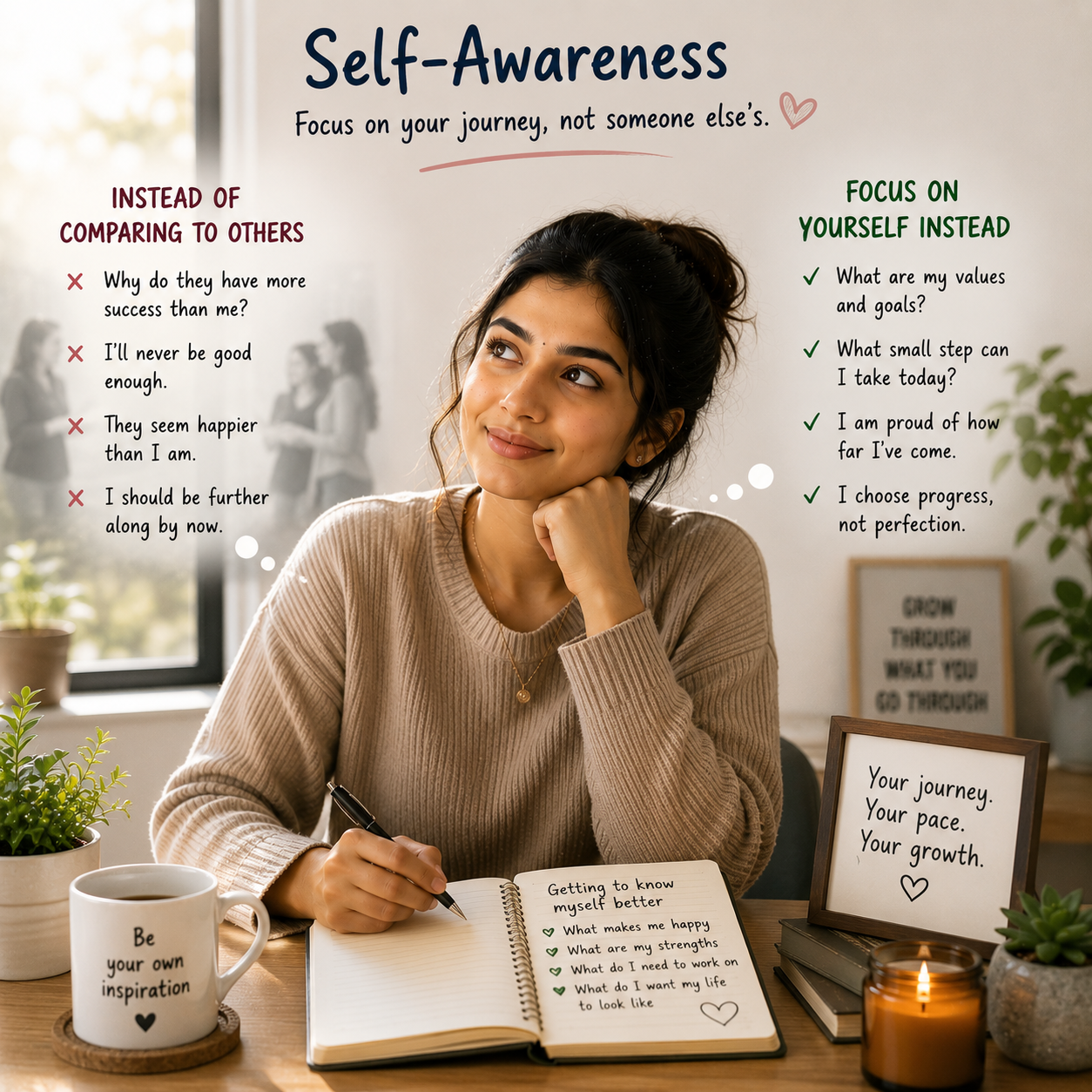
Learning to stop comparing yourself does not mean ignoring other people’s achievements. Instead, it means directing your attention toward your own goals, values, and progress.
Comparing yourself to others is something almost everyone experiences. You may notice another person’s career, lifestyle, appearance, relationships, achievements, or social media posts and wonder why your own life looks different.
Occasional comparison is natural. However, constantly comparing yourself to others can make it difficult to notice your own progress and appreciate what you already have.
Fortunately, this is a skill that can improve with practice. Small changes in the way you think, use social media, and measure success can gradually build greater confidence and self-awareness.
In this article, you will discover eight practical ways to stop comparing yourself to others and develop a healthier view of your own journey.
Why We Compare Ourselves to Others
Comparison often happens automatically. For example, seeing someone your age achieve something you have not reached yet may suddenly make your own progress seem less important.
Social media can make this feeling stronger. People usually share selected moments from their lives rather than showing every challenge, setback, or ordinary day.
As a result, you may compare your complete everyday experience with someone else’s carefully selected highlights.
Constant comparison can contribute to:
- Lower confidence
- Unnecessary stress
- Negative self-talk
- Frustration
- Unrealistic expectations
- Reduced motivation
- Feelings of inadequacy
Therefore, learning how to manage comparison can become an important part of personal growth.
8 Ways to Stop Comparing Yourself to Others
1. Remember That Everyone Has a Different Starting Point
People do not begin life with the same circumstances. Background, opportunities, responsibilities, resources, experiences, and priorities can all be different.
Because of these differences, comparing your progress directly with someone else’s may not provide a fair picture.
For example, two people may have the same career goal but completely different starting points. One person might have more experience, while another may have different responsibilities or opportunities.
Instead of asking:
“Why am I not where they are?”
Try asking:
“What can I do with where I am today?”
This small change can make your goals feel more realistic and personal.
2. Focus on Your Own Progress
One of the most useful ways to stop comparing yourself is to compare your current self with your past self.
Take a moment to ask:
- What have I learned recently?
- What am I doing better?
- Which habit have I improved?
- What challenge have I handled?
- What progress have I made this year?
Perhaps you could not speak confidently during meetings a year ago. Today, you may feel more comfortable sharing your ideas.
That progress matters.
Furthermore, personal growth does not always happen in ways that other people can see. Improved confidence, better habits, emotional growth, and greater self-awareness may not appear in a social media post, yet they are still meaningful achievements.
3. Be Careful With Social Media
Social media can provide useful connections, entertainment, and inspiration. At the same time, endless scrolling may encourage unhealthy comparison.
You might see someone’s new job, holiday, achievement, home, fitness progress, or relationship and compare it with your own life.
Remember that you are usually seeing only a small part of that person’s reality.
For a healthier digital experience, consider:
- Unfollowing accounts that consistently make you feel inadequate
- Taking regular social media breaks
- Limiting unnecessary scrolling
- Following accounts that provide useful or positive content
- Avoiding social media when you are already feeling low
Creating a healthier digital environment can make it easier to focus on your own priorities.
4. Turn Comparison Into Inspiration
Not every comparison has to become negative. Sometimes, another person’s success can show you what may be possible.
Instead of thinking:
“They’re better than me.”
Try asking:
“What can I learn from their approach?”
Maybe they developed an effective study routine, learned a useful skill, or created a habit that helped them move forward.
You do not need to copy their entire life. Simply identify one useful idea and adapt it to your own situation.
As a result, comparison can become an opportunity to learn rather than a reason to criticize yourself.
5. Recognize Your Own Strengths
Comparison often directs attention toward what we believe we lack. Consequently, it becomes important to notice what you already do well.
Think about your:
- Skills
- Experiences
- Personality strengths
- Values
- Achievements
- Relationships
- Lessons learned
You could also write down three strengths at the end of each week.
These strengths do not need to be major achievements. For example, you might write:
“I stayed consistent with my studies.”
“Another strength is that I handled a difficult conversation calmly.”
“I also helped someone who needed support.”
Small examples like these can remind you that your value is not determined by comparison.
6. Set Personal Goals
Comparison can become stronger when you do not have clear goals of your own. Instead of constantly watching what other people are doing, first decide what matters to you. Then, focus your time and energy on those goals.
Your goals might include:
- Improving your skills
- Becoming healthier
- Learning something new
- Saving money
- Building better relationships
- Becoming more confident
- Creating a healthier routine
Once you have clear goals, measure your progress against your own starting point. This way, you can see how far you have come.
For instance, if your goal is to improve your writing, success does not depend on whether another person writes better than you. Instead, look at how your own writing has changed.
Ask yourself:
“Am I improving compared with where I was before?”
This creates a more meaningful way to measure progress.
7. Challenge Negative Thoughts
Sometimes comparison creates thoughts that sound like facts.
For example:
“Everyone is doing better than me.”
But is that really true?
Probably not.
When a negative comparison appears, pause before accepting the thought as reality. Then ask:
“What evidence supports this thought?”
Follow up with another question:
“What evidence might I be ignoring?”
You may discover that you are focusing on one person’s visible achievement while forgetting your own progress.
As a result, challenging negative thoughts can help you develop a more balanced view.
8. Practise Gratitude for Your Own Life
Gratitude can redirect your attention toward what you already have. At the end of the day, write down three things you appreciate.
They could be simple moments such as:
- A good conversation
- A productive study session
- Time with family
- A peaceful walk
- Learning something new
- Finishing an important task
The goal is not to pretend that everything is perfect. Instead, gratitude helps you notice positive parts of your life that comparison may hide.
Over time, this practice can help you appreciate your own journey.
What to Do When Comparison Happens
You probably will not eliminate comparison completely. It may still appear from time to time, especially when you encounter someone else’s success.
When it happens, try this simple process:
Notice
Recognize that you are comparing yourself to someone else.
Pause
Give yourself a moment before accepting the negative thought.
Question
Ask whether the comparison is fair, realistic, and based on complete information.
Redirect
Bring your attention back to your own priorities and goals.
Act
Take one small step toward something that matters to you.
This approach turns an unhelpful thought into an opportunity to refocus.
Stop Comparing Your Timeline
There is no universal timeline for success. One person may start a career early, while another may change careers later.
Someone might achieve financial stability quickly. Another person may spend years building it.
A person could discover their passion at eighteen. Someone else may find meaningful work at forty.
Therefore, being behind another person does not automatically mean you are failing.
Your timeline is influenced by your circumstances, choices, opportunities, responsibilities, and priorities. What matters most is whether you are moving in a direction that feels meaningful to you.
Comparison and Self-Worth Are Not the Same Thing
Someone else’s success does not reduce your value. Another person’s achievement can exist without making your own accomplishments less important.
For example, if a friend receives a promotion, that does not mean your current job has less value. Similarly, if someone learns a skill faster than you, that does not mean you are incapable of learning it.
Therefore, try to separate achievement from self-worth.
You are more than your job title, grades, income, appearance, productivity, or accomplishments.
Developing self-compassion can also help you respond to mistakes and perceived shortcomings with greater kindness. The American Psychological Association describes self-compassion as taking a noncritical approach to your own inadequacies and failures.
A Simple Daily Practice to Stop Comparing Yourself
If comparison is a regular problem, try this five-minute exercise.
Step 1
Write down one comparison you noticed today.
Step 2
Ask yourself why it affected you.
Step 3
Identify one thing you appreciate about your own life.
Step 4
Write down one area you would like to improve.
Step 5
Choose one small action for tomorrow.
This simple practice can gradually shift your attention away from comparison and toward personal growth.
Final Thoughts
Learning to stop comparing yourself is not about becoming indifferent to other people’s success. Instead, it means recognizing that someone else’s journey is not a reliable measurement of your own.
Focus on your progress. Protect your attention. Question negative comparisons. Celebrate small improvements. Set goals that genuinely matter to you.
Most importantly, remember that growth does not happen on one universal schedule.
You do not need to have someone else’s life to build a meaningful one. Your task is to understand where you are, decide where you want to go, and take the next step.
If you want to build a kinder relationship with yourself, read our article Self-Compassion: How to Be Kinder to Yourself Every Day.
For additional information about social comparison, self-worth, and emotional well-being, explore resources from the American Psychological Association (APA).
Frequently Asked Questions
1. Why do I compare myself to others?
Comparison can happen because of insecurity, social pressure, competition, uncertainty, or exposure to other people’s achievements. Social media can also make comparison more frequent.
2. How can I stop comparing myself to others?
Start by noticing when comparison happens. Then question whether the comparison is fair, redirect your attention toward your own goals, and measure progress against your previous self.
3. Is Comparing Yourself always bad?
No. Comparison can sometimes provide useful information or inspiration. The problem occurs when it repeatedly damages your confidence or makes you feel inadequate.
4. How does social media affect comparison?
Social media often shows selected moments from people’s lives. Therefore, comparing your complete everyday experience with carefully selected online content can create unrealistic expectations.
5. What should I compare myself with instead?
Compare your current progress with your previous progress. Ask what you have learned, improved, completed, or handled better than before.