
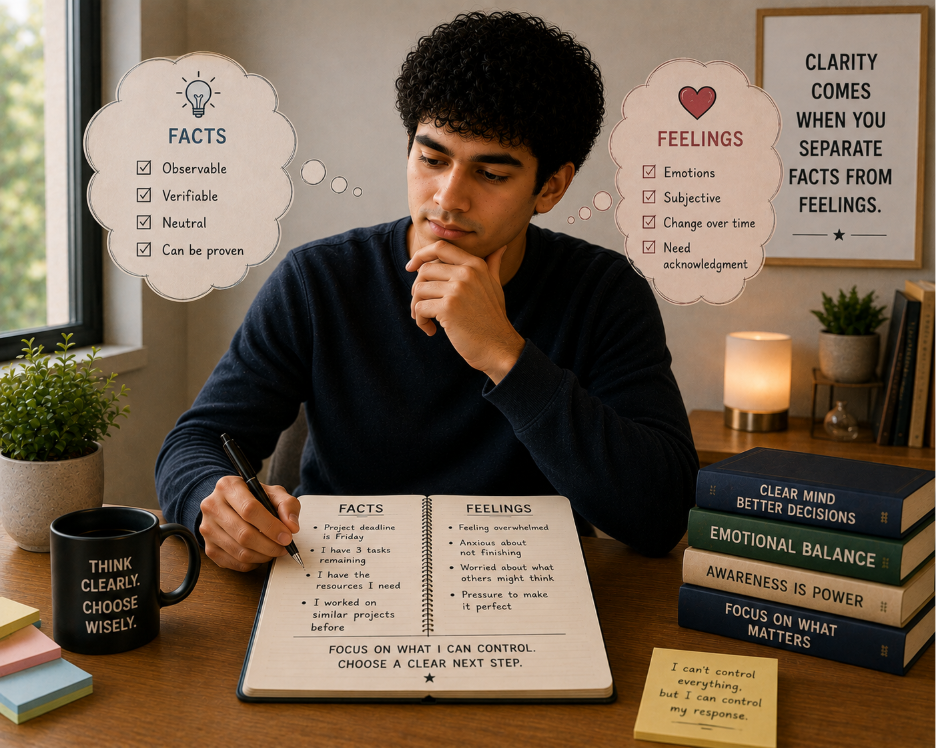
Learning to separate facts from feelings can help you slow down, look at the situation more clearly, and make thoughtful choices. It does not mean ignoring your emotions. Instead, it means recognizing what you feel while also checking what you actually know.
For more information about emotions, behavior, and mental well-being, explore resources from the American Psychological Association.
Why You Need to Separate Facts From Feelings
Facts and feelings are both important, but they serve different purposes.
A fact is something that can be observed or verified. A feeling is your emotional response to an experience.
For example, imagine that a friend does not reply to your message.
The fact is that your friend has not replied.
You may feel worried, rejected, or disappointed. However, those feelings do not tell you why the person has not responded.
Maybe they are busy. Perhaps they have not seen the message. There could be another reason you do not know yet.
When you separate facts from feelings, you give yourself time to understand the situation before creating a conclusion.
8 Ways to Separate Facts From Feelings
1. Pause Before You React
Strong emotions can create an urge to respond immediately.
Before sending an angry message or making an important decision, take a short pause.
Ask yourself:
- What happened?
- What am I feeling?
- What do I actually know?
- Am I reacting to a fact or an assumption?
A short pause can create enough space to choose a calmer response.
2. Identify What You Know for Certain
Start with information you can confirm.
Suppose your manager asks you to change part of a report. You might immediately think that your work was poor.
However, the confirmed information is simply that your manager asked for a change.
The thought that your work was a failure is an interpretation.
Focus first on what you can verify. Then consider what the situation might mean.
3. Separate Facts From Feelings
When something bothers you, write down the facts and feelings separately.
Facts:
- What happened?
- What was said?
- What can I verify?
Feelings:
- What emotion am I experiencing?
- Am I angry, worried, disappointed, or confused?
- Why might this situation affect me strongly?
This simple exercise can make your thoughts easier to understand.
4. Question Your Assumptions
Our minds often fill gaps when we do not have enough information.
Someone giving you a short reply does not automatically mean they are angry. A friend cancelling plans does not necessarily mean they no longer value the friendship.
Ask yourself:
“What else could be true?”
Considering another explanation does not mean your first thought is always wrong. It simply prevents you from treating an assumption as a fact.
5. Look for Evidence
Once you identify an assumption, check the available evidence.
If you think someone is upset with you, ask what actually happened. Did they clearly say they were upset? Or are you interpreting their behavior based on how you feel?
Evidence can help you create a more balanced view.
Instead of asking, “What if my fear is true?” also ask, “What evidence do I have?”
6. Consider Other Perspectives
Another person’s view can sometimes reveal information you missed.
Try asking:
- How might another person see this situation?
- Am I missing some information?
- Is there another reasonable explanation?
- Would I think differently if I were calmer?
You do not have to agree with every perspective. The goal is to avoid making a conclusion based only on your current emotional state.
7. Avoid Important Decisions During Strong Emotions
Strong emotions can affect judgment.
When you are extremely angry, worried, or upset, you may focus on what feels right in the moment rather than what will help you later.
If possible, give yourself time before making an important decision.
You might say:
“I need some time to think about this.”
Taking a pause does not mean avoiding the problem. It gives you an opportunity to understand it before responding.
8. Use Facts and Feelings Together
Learning to separate facts from feelings does not mean choosing facts and ignoring emotions.
Your emotions can tell you that something matters.
Anger may show that you feel unfairly treated. Anxiety may highlight uncertainty. Disappointment may point to an unmet expectation.
However, emotions do not always explain the entire situation.
A useful question is:
“What am I feeling, and what do the facts tell me?”
This allows you to respect your emotions while still thinking carefully.
How to Separate Facts From Feelings at Work
Work can create situations where emotions and assumptions become mixed together.
A short email from a manager might make you worry about your performance. Feedback from a coworker might make you feel embarrassed. A missed opportunity might make you question your abilities.
Start by separating the situation from your interpretation.
For example:
Fact: Your manager asked you to revise a report.
Feeling: You feel worried that your work was not good enough.
The fact tells you what needs attention. The feeling tells you how the situation affected you.
Once you recognize both, you can focus on what you can actually improve.
How to Separate Facts From Feelings in Relationships
Relationships can bring strong emotions, especially when communication is unclear.
A friend may cancel plans. A partner may respond differently than usual. Someone may disagree with your opinion.
Your first reaction might be to assume what their behavior means.
Instead, look at what actually happened.
Ask yourself:
- What did they say?
- What did they do?
- What am I assuming?
- Do I have enough information?
- Could I ask them directly?
Clear communication can often replace assumptions with useful information.
Separate Facts From Feelings Without Ignoring Emotions
Being rational does not mean becoming emotionless.
Feelings are part of how we understand our experiences. They can highlight concerns, needs, values, and expectations.
The important part is not allowing one emotional reaction to become the entire story.
Instead of thinking:
“I feel anxious, so something must be wrong.”
Try:
“I feel anxious, so I should slow down and understand what is happening.”
That small change can help you respond with greater awareness.
A Simple Daily Practice for Clearer Thinking
You can practice this skill whenever something makes you uncomfortable.
Write down five things:
1. What happened?
Describe the situation using only information you can verify.
2. What am I feeling?
Name the emotion.
3. What am I assuming?
Identify the conclusion your mind is making.
4. What evidence do I have?
Look for information that supports or challenges your assumption.
5. What is the most reasonable next step?
Choose an action based on the situation rather than your strongest emotion.
With regular practice, this process can become easier.
Final Thoughts on Separating Facts From Feelings
Learning to separate facts from feelings can help you respond to difficult situations with greater clarity.
Facts help you understand what happened. Feelings help you understand how the experience affected you.
Neither one needs to be ignored.
Instead, notice your emotions, check the facts, question your assumptions, and give yourself time before reacting.
You do not need to stop feeling in order to think rationally. Clear thinking means making room for both emotion and reason.
For another Rational Works resource, you can also explore Building Self-Awareness.
Frequently Asked Questions About Separating Facts From Feelings
What does it mean to separate facts from feelings?
It means recognizing the difference between what you can verify and how you emotionally respond to that situation.
Does separating facts from feelings mean ignoring emotions?
No. Feelings are important. The goal is to understand your emotions without automatically treating them as proof of what happened.
Why do feelings sometimes feel like facts?
Strong emotions can make our interpretations feel certain. However, a strong feeling does not always mean that our interpretation is accurate.
How can I think clearly when I am emotional?
Pause before reacting, name the emotion, identify the facts, question your assumptions, and give yourself time before making important decisions.
Can separating facts from feelings improve decision-making?
Yes. Looking at evidence while recognizing your emotions can help you avoid impulsive decisions and make more balanced choices.