
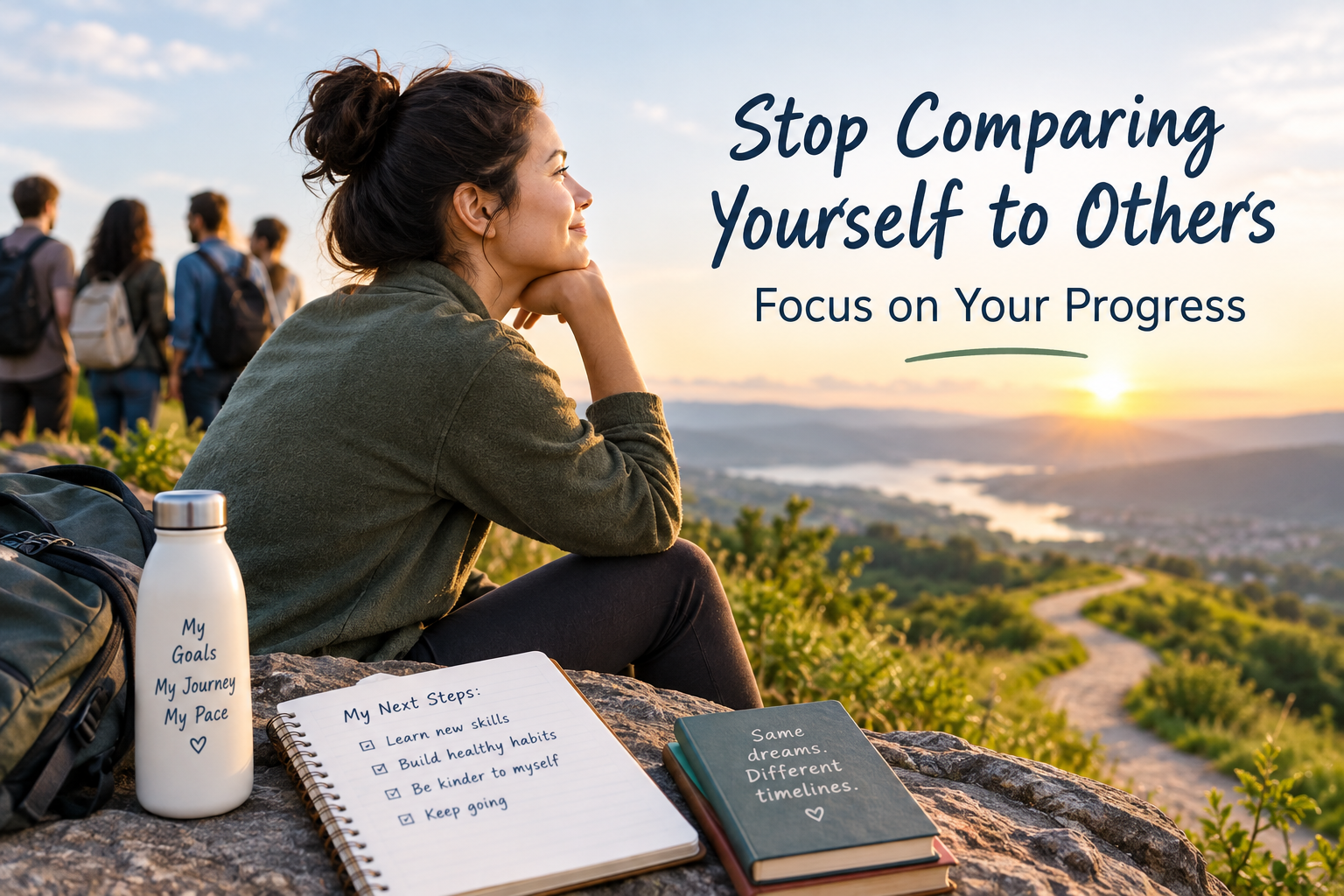
Learning to stop comparing yourself to others does not mean ignoring other people’s achievements. Instead, it means using your own life as a healthier point of reference.
It is easy to compare yourself with other people. You may see someone who seems more successful, confident, fit, productive, or happy and wonder why your life does not look the same.
Occasional comparison is normal. However, constantly measuring your life against other people can make you lose sight of your own progress.
Your journey has its own pace, challenges, priorities, and opportunities.
Here are eight practical ways to stop comparing yourself to others and focus more on your own growth.
1. Notice When Comparison Starts
The first step is becoming aware of your comparison habits.
Comparison may begin when you scroll through social media, hear about someone else’s success, talk with friends, or receive feedback at work.
You might suddenly think:
- “They are doing much better than me.”
- “I should be further ahead.”
- “Why can’t I have what they have?”
- “Everyone else seems to have things figured out.”
These thoughts can appear quickly. Therefore, notice them before they turn into harsh judgments.
Pause and ask:
“What triggered this comparison?”
Once you understand your triggers, you can respond more thoughtfully instead of automatically comparing yourself.
2. Compare Yourself With Your Past Self
A healthier comparison is often between who you are today and who you were before.
Think about what has changed over the past year or even the past few months.
Ask yourself:
- What can I do now that I could not do before?
- What have I learned?
- Which habits have improved?
- What challenges have I handled better?
- Where have I become more confident?
Your progress may be easier to notice when you look backward instead of sideways.
Small changes matter because they show movement. Even when the final goal is still far away, your previous efforts can provide useful evidence of growth.
For more practical strategies, read How to Build Self-Awareness: 8 Ways to Understand Yourself Better.
3. Remember That You See Only Part of Someone Else’s Story
Comparison often becomes unfair because you are comparing your full life with a small part of someone else’s.
You may see another person’s promotion, vacation, relationship, fitness progress, or achievement.
What you may not see are the problems, delays, doubts, mistakes, or difficult circumstances behind that moment.
Social comparison research has examined how comparing yourself with others can affect how you evaluate yourself. The effect can also depend on the situation and the person being compared with.
So, when you catch yourself thinking that someone else’s life is better, pause.
You are looking at one part of their story.
Your own life contains much more than what you choose to show other people.
4. Use Social Media More Intentionally
Social media can make comparison easier because you are constantly exposed to other people’s updates.
A simple solution is not necessarily deleting every app. Instead, become more intentional about how you use them.
You can:
- Unfollow accounts that make you feel inadequate.
- Mute content that repeatedly triggers comparison.
- Take breaks from scrolling.
- Avoid checking social media when you already feel discouraged.
- Spend more time on content that informs or inspires you without making you judge yourself.
The goal is to create more space between seeing someone else’s life and forming a negative opinion about your own.
When comparison becomes a repeated source of stress, changing your digital habits can help.
5. Define What Success Means to You
Comparison becomes stronger when you have not decided what matters to you.
One person may define success through career growth. Another may care more about family, health, creativity, learning, financial stability, or peace of mind.
Your goals do not have to match someone else’s.
Write down three things that matter most to you right now.
Then ask:
“Am I building a life around these values, or am I chasing what looks impressive to someone else?”
Having your own definition of success makes comparison less powerful.
You stop asking, “Am I ahead of them?”
Instead, you start asking, “Am I moving in a direction that matters to me?”
6. Turn Envy Into Information
Feeling jealous or envious does not automatically make you a bad person.
Sometimes these feelings point toward something you want.
You might envy someone’s confidence because you want to speak up more. Perhaps another person’s career success reminds you that you want to develop new skills. Someone else’s healthy routine may show you that your own habits need attention.
Instead of criticizing yourself for the feeling, ask:
“What is this comparison showing me that I want?”
Then turn the answer into a practical step.
For example, if you admire someone’s communication skills, practice expressing your thoughts more clearly.
Comparison becomes more useful when you treat it as information rather than proof that you are not good enough.
7. Practice Positive Self-Talk
The way you talk to yourself can make comparison better or worse.
After seeing someone else’s success, you might immediately think:
“I’m falling behind.”
Try replacing that statement with something more balanced:
“Their progress does not cancel mine.”
You could also say:
- “I am allowed to move at my own pace.”
- “I can learn without being perfect.”
- “Someone else’s success does not make mine impossible.”
- “I can focus on my next step.”
Positive self-talk is not about pretending everything is perfect.
Rather, it helps you respond to yourself with greater fairness and encouragement.
8. Focus on Your Next Step
Comparison often becomes overwhelming when you think about everything you have not achieved.
Instead, bring your attention back to one action.
Ask:
“What can I do today that moves me forward?”
You might spend thirty minutes learning a skill, make an important phone call, exercise, finish a task, or simply rest when rest is what you need.
Progress becomes easier to manage when you focus on actions instead of rankings.
One useful step today is more valuable than spending hours wondering why someone else seems further ahead.
Stop Comparing Yourself to Others Without Losing Motivation
Stopping comparison does not mean becoming comfortable with doing nothing.
You can still have ambitious goals.
You can admire successful people.
You can learn from others.
The difference is that their achievements do not have to become a measurement of your worth.
Use other people’s progress as information when it helps you learn. Then return your attention to your own goals.
For more support with confidence, explore Building Self-Confidence.
Stop Comparing Yourself to Others on Difficult Days
Comparison can feel stronger when you are already tired, disappointed, or uncertain.
On those days, avoid making broad judgments about your life.
You do not need to solve everything immediately.
Take a break. Reduce unnecessary pressure. Focus on one manageable task.
Afterward, return to your longer-term goals with a clearer mind.
You can also remind yourself that progress is not always visible from day to day.
How Comparison Affects Everyday Life
Constant comparison can influence how you feel about work, relationships, appearance, money, learning, and personal growth.
At work, you may feel behind when a colleague receives recognition.
In relationships, you may wonder why your life does not look like someone else’s.
Online, carefully selected images can make ordinary life seem less interesting.
The answer is not to stop noticing other people.
Instead, keep returning to your own values, goals, and progress.
Frequently Asked Questions
Is it normal to compare yourself with others?
Yes. Comparison is a common part of how people evaluate themselves. The problem begins when it becomes constant or leads to harsh self-judgment.
How can I stop comparing myself on social media?
Start by noticing which accounts trigger negative comparisons. Then mute or unfollow them, take regular breaks, and spend more time on content that supports your goals.
Why do I feel behind everyone else?
You may be focusing on visible achievements while ignoring your own progress and the unseen parts of other people’s lives. Your timeline does not need to match someone else’s.
Can comparison ever be useful?
Yes. Comparison can sometimes show you what you value or what you want to learn. The key is turning that information into action instead of self-criticism.
How do I focus more on myself?
Set personal goals, track your progress, define your values, reduce comparison triggers, and focus on your next useful step.
Final Thoughts On Stop Comparing Yourself to Others
Learning to stop comparing yourself to others is not about becoming disconnected from the world around you.
It is about remembering that your life cannot be fairly measured against someone else’s highlight reel.
Notice comparison when it starts.
Question what it is telling you.
Return to your own goals.
Celebrate small improvements.
Most importantly, remember that progress does not have to look impressive to be real.
Your journey has its own pace.