
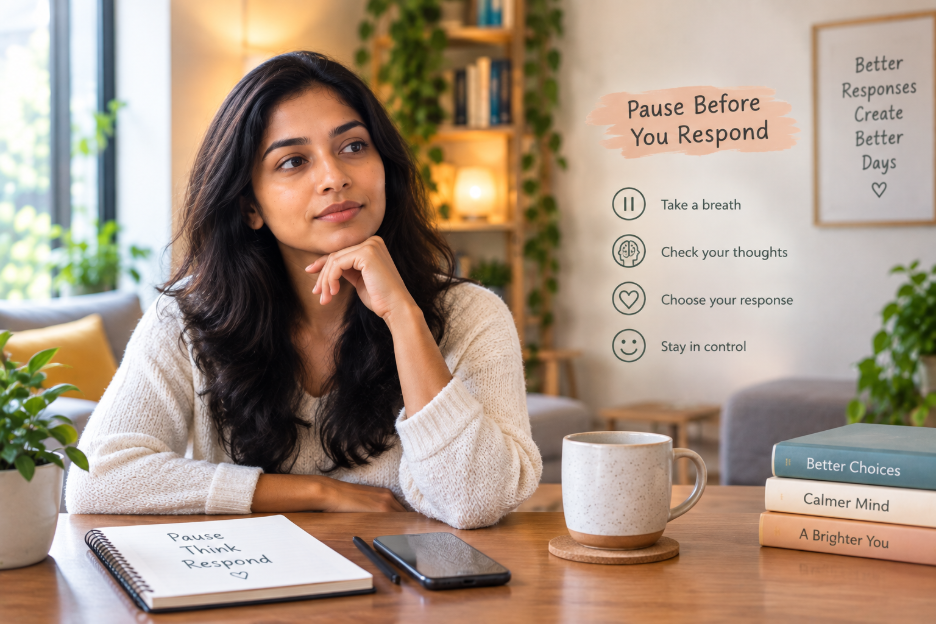
Learning to become less reactive does not mean ignoring your emotions or pretending that nothing bothers you. Instead, it means creating a small space between what happens and how you respond.
That space can help you slow down, understand what you are feeling, and choose a response that reflects your values rather than your first emotional impulse.
The goal is not to control every emotion. The goal is to become better at managing your reactions so you can communicate clearly, handle challenges, and protect your mental well-being.
1. Notice Your Early Warning Signs
One of the first steps to become less reactive is learning to recognize what happens in your body and mind before you react.
Strong emotional reactions often come with physical and mental signals. You may notice:
- Muscle tension
- A faster heartbeat
- Tightness in your chest
- Faster breathing
- Racing thoughts
- A strong urge to defend yourself
- Irritation or impatience
- The feeling that you must respond immediately
These signs can act as an early warning system.
For example, if you notice your shoulders becoming tense during a difficult conversation, that may be a signal to slow down before continuing.
Try asking yourself:
“What am I feeling right now, and what is happening in my body?”
This simple question can help you notice your reaction before it becomes an automatic response.
2. Create a Pause Before Responding
A pause can change the direction of a conversation.
When emotions are strong, you do not always need to respond immediately. Taking a few seconds to breathe and collect your thoughts can prevent words or actions you may later regret.
You can try:
- Taking two or three slow breaths
- Counting slowly to five
- Drinking some water
- Waiting before sending a message
- Stepping away briefly when appropriate
- Asking for more time to think
Simple phrases can also create space:
- “Let me think about that.”
- “I need a moment before I respond.”
- “Can we come back to this conversation?”
- “I want to understand what you mean.”
A pause is not weakness. It is a practical way to become less reactive and respond with greater awareness.
3. Question Your First Interpretation
Sometimes the strongest part of a reaction comes from the meaning we give to an event.
Someone may give you short feedback, for example, and you may immediately think:
“They are criticizing me.”
But another explanation could be:
“They are trying to point out something I can improve.”
The first interpretation is not always the most accurate one.
Before reacting, ask:
- What actually happened?
- What am I assuming?
- Do I have enough information?
- Is there another possible explanation?
- Am I reacting to the current situation or something from the past?
Separating facts from assumptions can make it easier to respond calmly. If you tend to overthink situations after emotional interactions, practicing awareness of your thoughts can also help.
Instead of automatically believing your first thought, give yourself permission to examine it.
4. Avoid Responding at the Peak of Emotion
When anger, fear, or frustration is at its highest point, problem-solving can become more difficult.
You may speak more harshly than you intended, send an impulsive message, or make a decision based mainly on emotion.
If possible, give yourself time to settle.
You could:
- Take a short walk
- Practice slow breathing
- Move to another room
- Listen to calming music
- Write down what you are feeling
- Wait before responding to a difficult message
The goal is not to avoid the problem. The goal is to approach it when you are more able to think clearly.
This is especially useful when you notice that your emotional response is becoming stronger with every minute.
5. Focus on Solving the Problem Instead of Winning
During disagreements, it can be tempting to prove that you are right.
However, trying to win an argument can increase defensiveness on both sides.
Instead, ask:
“What would actually improve this situation?”
This question changes your attention from winning to resolving.
For example, instead of saying:
“You never listen to me.”
You might say:
“I feel frustrated when I do not feel heard. Can we talk about what happened?”
The second approach does not remove your feelings. It communicates them in a way that leaves more room for discussion.
Learning to become less reactive often means replacing the need to win with the desire to understand and solve.
6. Practice Responding More Slowly
Fast responses are not always better responses.
In conversations, work situations, and relationships, you may feel pressure to answer immediately. However, giving yourself time to think can improve the quality of your response.
Try using phrases such as:
- “Let me check and get back to you.”
- “I want to think about this first.”
- “Can I respond after I have had some time?”
- “I understand your point. Let me consider it.”
This habit can be particularly useful when you are dealing with criticism, conflict, or important decisions.
Slowing down also gives you an opportunity to notice your thoughts, emotions, and assumptions.
Developing stronger self-awareness can make this process easier because you become more familiar with the situations that tend to trigger you.
7. Learn From Your Reactions
Everyone reacts poorly sometimes.
Instead of criticizing yourself after a difficult moment, use the experience as information.
After you react, ask yourself:
- What triggered me?
- What was I feeling?
- What did I assume?
- What did I say or do?
- What happened afterward?
- What could I do differently next time?
For example, you may realize that you become especially reactive when you feel ignored, rushed, misunderstood, or criticized.
Once you recognize the pattern, you can prepare for it.
You might decide to take a pause, ask for clarification, or step away before responding the next time a similar situation occurs.
Self-reflection can turn a difficult experience into an opportunity to improve.
8. Build a Life With More Room to Respond
It is harder to regulate your reactions when you are constantly rushed, exhausted, or overwhelmed.
Everyday habits can influence how much emotional space you have.
Consider creating more room by:
- Getting enough sleep
- Taking regular breaks
- Limiting unnecessary notifications
- Making time for physical activity
- Spending time outdoors
- Practicing mindfulness
- Maintaining supportive relationships
- Avoiding unnecessary multitasking
Small changes can reduce the sense that everything needs an immediate response.
A calmer daily routine does not prevent difficult situations. However, it can give you more mental energy to handle them.
How to Become Less Reactive Without Suppressing Your Emotions
Being less reactive does not mean becoming emotionally distant.
Emotions provide useful information. Anger may tell you that something feels unfair. Anxiety may signal uncertainty. Disappointment may point to an unmet expectation.
The goal is not to eliminate these emotions.
Instead, learn to notice them without allowing them to automatically control your behavior.
For example, you can feel angry and still choose to speak calmly.
You can feel anxious and still take time to gather information.
You can feel disappointed and still communicate respectfully.
Emotional awareness and emotional control can work together.
If you want to strengthen this skill, practicing self-awareness, mindfulness, and emotional intelligence can help you understand your reactions more clearly.
How to Become Less Reactive at Work and in Relationships
Reactivity can affect almost every area of life.
At work, an immediate response to criticism can create unnecessary tension with coworkers. In relationships, reacting defensively can turn a small disagreement into a larger conflict.
Try applying the same principles in both situations:
Pause. Notice. Think. Respond.
At work, you might wait before replying to a frustrating email.
In a relationship, you might say, “I want to talk about this, but I need a few minutes first.”
With family members, you might ask a clarifying question instead of assuming you know their intention.
These small changes can improve communication and reduce unnecessary conflict.
Healthy boundaries can also help when certain situations repeatedly leave you feeling overwhelmed or emotionally drained.
How to Become Less Reactive After You React
Sometimes you will react before you have time to think.
That does not mean you have failed.
What matters is what you do afterward.
If you realize that your response was too harsh, consider acknowledging it.
You might say:
“I reacted too quickly. I was frustrated, but I could have handled that better.”
Taking responsibility does not mean blaming yourself. It means recognizing your behavior and making an effort to repair the situation.
You can then ask yourself what triggered the reaction and what you can do differently next time.
Repair is an important part of emotional growth.
When Strong Reactions Feel Difficult to Manage
Occasional emotional reactions are normal. However, if intense reactions are frequent, difficult to control, or interfering with your relationships, work, or daily life, consider speaking with a qualified mental health professional.
A professional can help you understand emotional patterns, identify triggers, and develop healthier coping strategies.
For reliable information about mental health and emotional well-being, resources from organizations such as the American Psychological Association can also provide useful educational guidance.
Seeking support is not a sign that you are weak. It can be a practical step toward better emotional health.
Frequently Asked Questions
What does it mean to become less reactive?
To become less reactive means learning to create space between an event and your response. Instead of automatically acting on your first emotional impulse, you pause, consider what is happening, and choose how to respond.
Why do I react so quickly?
Quick reactions can be influenced by stress, habits, past experiences, strong emotions, fatigue, or feeling threatened or misunderstood. Learning to recognize your triggers can help you slow down.
How can I stop reacting immediately when I am angry?
Start by noticing your physical warning signs. Then pause, take a few slow breaths, and give yourself time before speaking or sending a message. If necessary, step away and return to the conversation later.
Does becoming less reactive mean becoming emotionally distant?
No. Becoming less reactive does not mean suppressing emotions. It means learning to experience emotions while choosing how to express them.
How long does it take to become less reactive?
There is no fixed timeline. With regular practice, you may gradually become better at noticing triggers, pausing, and choosing more thoughtful responses. Progress usually comes from repeated small changes rather than one major transformation.
Final Thoughts
Learning to become less reactive is not about having perfect control over every emotion.
It is about creating enough space to make a choice.
You may still feel angry, anxious, frustrated, or disappointed. The difference is that you become more capable of deciding what to do with those feelings.
Start small. Notice your warning signs. Pause before responding. Question your assumptions. Learn from difficult moments. Create more space in your daily life.
Over time, these simple habits can help you move from automatic reactions toward thoughtful responses.
At Rational Works, we believe lasting well-being comes from practical, sustainable habits that help your mind and body work together. Becoming less reactive is one small but meaningful step toward greater emotional awareness, healthier communication, and a calmer everyday life.
“self-awareness” → Rational Works: Self-Awareness Daily Practices